Gertrude Wands
Mariners' Museum, Uncurated Search Results
Type: Skipjack
Year: 1899
Builder: John Branford
Location: Inverness

These records are found in the online catalog of The Mariners’ Museum and Park in Newport News, Virginia. Uncurated search results are presented to give researchers and interested readers an idea of whether the museum’s archives contain information about this vessel and whether it may be worthwhile to visit the museum’s catalog search page for further investigation. Uncurated results may be inaccurate or incomplete.
Search mode: Exact Name. Search phrase(s): "Gertrude Wands". Results returned: 5. Results displayed in this table: 5.
Use these buttons to send uncurated search results to your own app or text document for further research. First, check the box for any row, or click "Select All" then uncheck any rows. Then click "Show Selections". You can then copy your selections from the text box and past them into your app.
| Fetch? | Row ID | Media | Date | Vessel | Place | Related Places | Inscription/Marks | Subject | Notes | Archive Number |
|---|---|---|---|---|---|---|---|---|---|---|
| 1 | No image URL. | Gertrude Wands | P0001.011/01-1263 | |||||||
| 2 | 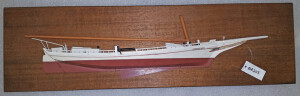 | SHORT DESCRIPTION: Half model of GERTRUDE WANDS, painted maroon below waterline, white above with red stripe. Gilt eagle head figurehead with green, red and blue painted trailboard. Deck rail, appropriate deck fittings. Cut off mast and boom. MODEL NOTES: Although originally cataloged as a two-sail bateau, this model by most definitions (DeKerchove, Kemp, Chapelle - although the latter somewhat contradicts himself) actually represents a skipjack: a V-bottomed, hard-chined, fully decked boat with one sharply raked mast and two triangular sails. DeKerchove says the types differ only in that the bateau is only partially decked, with cockpit and cuddy, while the skipjack is fully decked. "Skipjack" is also defined as just a rig (that described above); that also fits this model. ADDITIONAL INFORMATION: Chapelle, Howard I., "Notes on Chesapeake Bay Skipjacks," in AMERICAN NEPTUNE. Vol IV (1944), pp.269-303; also available as separate reprint. LABEL COPY: Skipjace Gertrude Wands/ (1899 - after 1943)/ Half model, scale 3/8"=1', circa 1954/ William E. Geoghegan, model maker/ Museum Collection/ 54.36 (label copy for Chesapeake Bay Gallery - September, 1989) VESSEL INFORMATION- VESSEL NAME: GERTRUDE WANDS NATIONALITY: American VESSEL TYPE: Skipjack or 2-Sail Bateau VESSEL DIMENSIONS: 42.6 x 14.3 x 3.4 ft; 8 gross tons SERVICE DATES: 1899- | CL14647 | |||||||
| 3 | 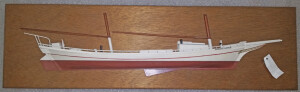 | MODEL NOTES: The bugeye, which gave its name to the rig used also on the three-sail bateau (see THELMA ROBERTS, MR 204/ 1954.35.1), was originally a wooden dugout boat, based on the earlier log canoes. In later years they were framed and planked, but with rounded bilge and longitudinal planking instead of the cross-planked bottom and hard-chine techniques used in the "bateau" or "skipjack" hulls (see GERTRUDE WANDS, MR 203/ 1954.36.1); their length-to-beam ratio was generally greater than that of bateau/ skipjack hulls, and they had narrow, pointed sterns, which were often surmounted with a wider platform, known as the "patent" stern. This allowed more room for working the helm and handling the push-boat. NORAH E. LAWSON combined the two construction methods: her bottom was of carved logs and her upper sides were framed and planked. The bugeye rig, with smaller sails than the two-masted bateau, allowed smaller crews because it was easier to handle in heavy weather, but it had less power in light winds. ADDITIONAL INFORMATION: Chapelle, Howard I., "Notes on Chesapeake Bay Skipjacks," in AMERICAN NEPTUNE. Vol IV (1944), pp.269-303; also available as separate reprint. LABEL COPY: Bugeye Nora Lawson (1896-circa 1946)/ Half model, scale 3/8"=1', circa 1954/ William E. Geoghegan, model maker/ Museum Collection/ 54.37 (label for Chesapeake Bay Gallery - September, 1989) VESSEL INFORMATION- VESSEL NAME: NORAH E. LAWSON NATIONALITY: American VESSEL TYPE: Bugeye VESSEL DIMENSIONS: 50.0 x 11.8 x 3.3 ft; 8 gross tons SERVICE DATES: 1896- SHIPBUILDER LOCATION: Maryland, Monie | CL24944 | |||||||
| 4 | 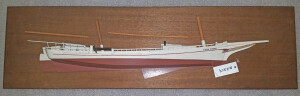 | MODEL NOTES: Rigged and cataloged as a three-sail bateau, which is believed to be the only type-name properly used for such two-masted vessels with a hull much like that of the single-masted (two-sail) bateau or "skipjack" (see GERTRUDE WANDS, MR 203/ 1954.36.1), but a little narrower relative to length. The THELMA G. ROBERTS' hull has a round stern, rather than transom, an allowable variant of the skipjack hull that is also found in the two-sail version. The three-sail bateau rig is shared by a round-bottomed boat called a "bugeye" (see NORA E. LAWSON, MR 205/ 1954.37.1). The bugeye rig, with smaller sails, allowed smaller crews because it was easier to handle in heavy weather, but it had less power in light winds. ADDITIONAL INFORMATION: Chapelle, Howard I., "Notes on Chesapeake Bay Skipjacks," in AMERICAN NEPTUNE. Vol IV (1944), pp.269-303; also available as separate reprint. LABEL COPY: Bateau Thelma Roberts (1897-1937)/ Half model, scale 3/8"=1', circa 1954/ William E. Geoghegan, model maker/ Museum Collection/ 54.35 (label for Chesapeake Bay Gallery - September, 1989) VESSEL INFORMATION-- VESSEL NAME: THELMA ROBERTS NATIONALITY: American VESSEL TYPE: 3 Sail Bateau SERVICE DATES: 1897-1937 BUILDER LOCATION: Maryland, Applegarth VESSEL DIMENSIONS: 6 gross tons; 45.3 x 14 x 2.7 | CL24943 | |||||||
| 5 | 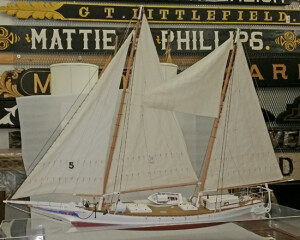 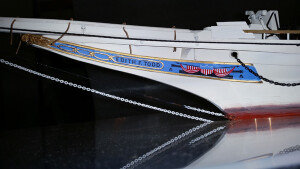 | SHORT DESCRIPTION: Bugeye with white hull, deck structure, bowsprit, push boat, parts of spare sail, red bottom, black iron work; brown/tan railings over white stanchions; trailboards blue, gold, red, white, and black; gold billet head. Set of four sails; numeral five on panel stitched to jib. Spars mostly natural. Name on trailboards and sides of stern. Rigged for carrying cargo; lacks winders and dredge rollers for oystering. Very nice trailboards, windlass, and planked deck. Model was entered in Mariners' 1980 Scale Ship Model Competition. NOTES: The bugeye, which gave its name to the rig used also on the three-sail bateau (see THELMA ROBERTS, MR 204/ 1954.35.1), was originally a wooden dugout boat, based on the earlier log canoes. In later years they were framed and planked, but with rounded bilge and longitudinal planking instead of the cross-planked bottom and hard-chine techniques used in the "bateau" or "skipjack" hulls (see GERTRUDE WANDS, MR 203/ 1954.36.1); their length-to-beam ratio was generally greater than that of bateau/ skipjack hulls, and they had narrow, pointed sterns, which were often surmounted, as in EDITH F. TODD, with a wider platform, known as the "patent" stern. This allowed more room for working the helm and handling the push-boat. EDITH F. TODD followed the original construction method, with a five-log hull. The bugeye rig, with smaller sails than the two-masted bateau, allowed smaller crews because it was easier to handle in heavy weather, but it had less power in light winds. NOTES: Hull from "Historic American Merchant Marine Survey" drawings Chapelle, Howard I., "Notes on Chesapeake Bay Skipjacks," in AMERICAN NEPTUNE. Vol IV (1944), pp.269-303; also available as separate reprint. See file for other sources. INVENTORY: box of parts - there is one (1) component part. VESSEL INFORMATION- VESSEL NAME: EDITH F. TODD ALL NAMES OF VESSEL: 1) EDITH F. TODD NATIONALITY: AMERICAN VESSEL TYPE: BUGEYE, KETCH VESSEL DIMENSIONS: 63.4 X 18.2 X 4.6 FT. SERVICE DATES: 1901-1947 SHIPBUILDER LOCATION: MARYLAND, ORIOLE DATE ABANDONED: 1947 ASSOCIATED (RELATED?) PLACES: CHESAPEAKE BAY | CL13148 |
Created 2026 by Don Barker, CBMM volunteer, for the Chesapeake Shipbuilding Project. shipbuilding@sailingworkboats.es